
《费曼物理学讲义》中介绍热力学的部分,设计了一个橡胶热机。
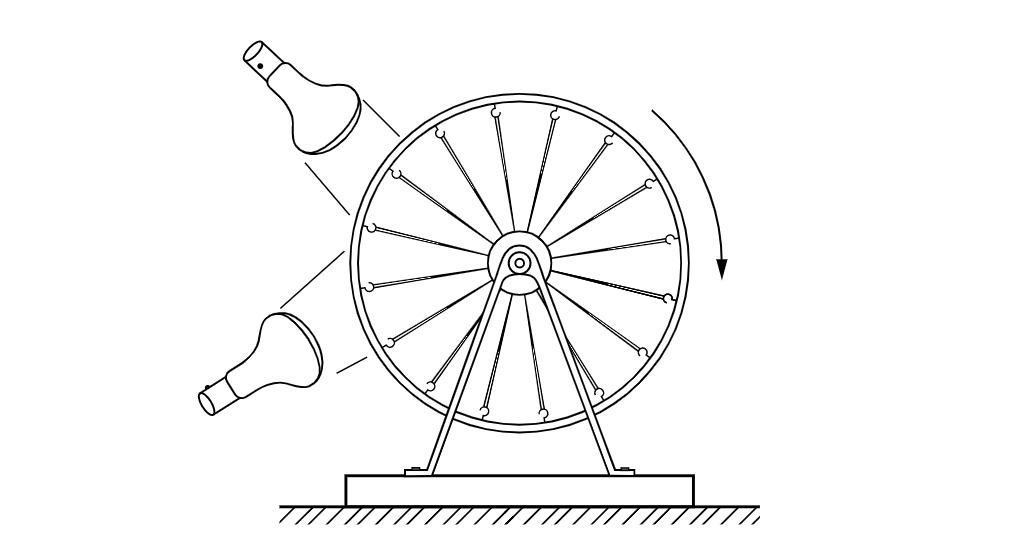
许多人复刻这个设计。YouTube上有很多视频了。比较值得注意的是Karlsruhe Institute of Technology做的原型,功率十分可观。
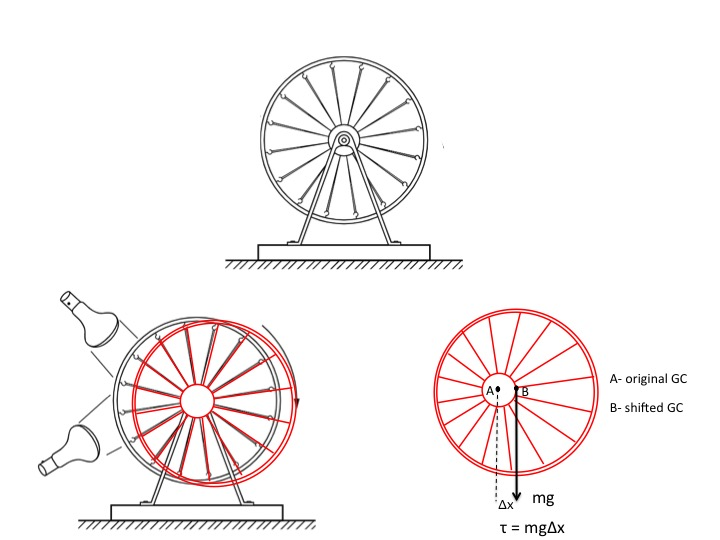
我一直以为,这个轮子的橡皮筋连到内圈上的位置是偏心的,以便当冷热两面皮筋张力有差异的时候,能制造出力矩不平衡,导致转动。但是这个帖子却介绍说,连接位置仍是中心对称的,造成不平衡的是外框形变程度不同,使得重力不平衡。
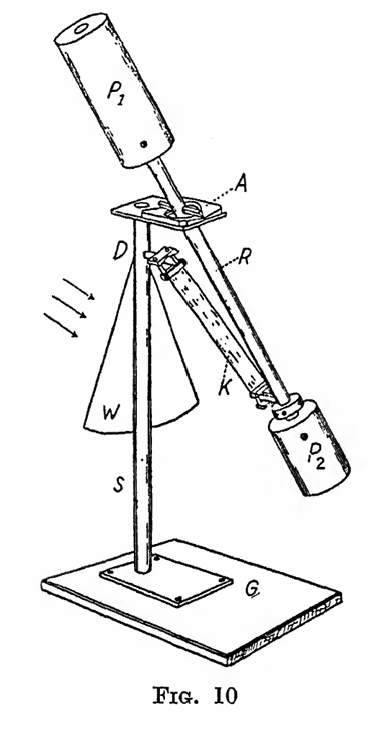
实际上比讲义(1960年代) 更早时,就已经有人利用橡胶的显著热弹性设计热机了,那就是Wiegand和Snyder的橡胶单摆[1]。其中一个模型在1933年芝加哥世博会连续运行了150天。
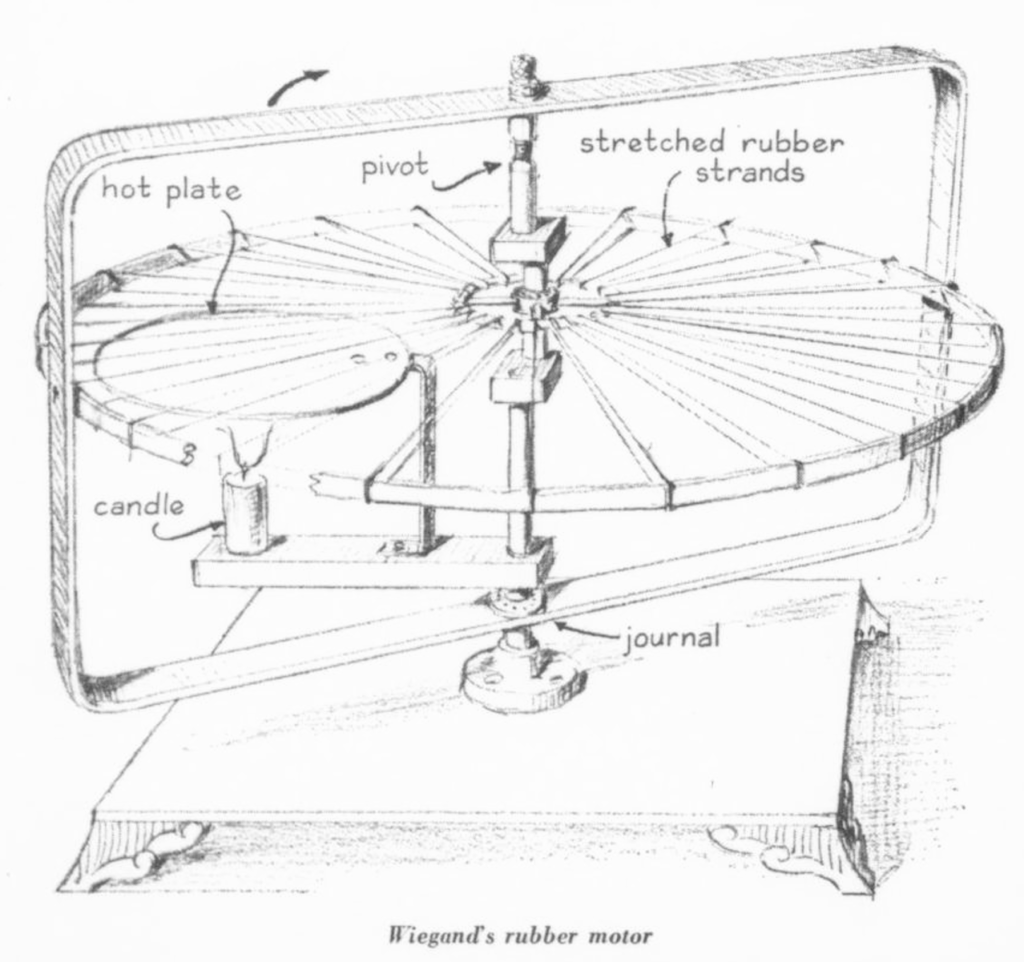
费曼的那种轮子设计,其实已经由Wiegand于1925年报道过。这个轮子是水平的。可以看到皮筋是以中心对称的位点连到内圈的。但注意到轮框是固定的,但内轴是曲辊,所以皮筋的张力差异能使曲辊旋转。而这种差异的周期变换需要外框相对蜡烛的旋转来实现。
50年代,生物体的弹性结缔组织(如筋腱)与橡胶弹性的相似性引起了一股研究热潮(Flory也陷到这里面去,争吵一直到他去世之后,这个以后再找时间写),因此也有人考虑过用筋腱做热机的想法[2]。R. Hayward在1956年5月的科学美国人上也展示了竖直轮的设计。Cox也报道[3]了竖直的轮子设计。这些报道清楚地表示这种设计是靠重力不平衡,不是靠我猜测的偏心扭矩不平衡。
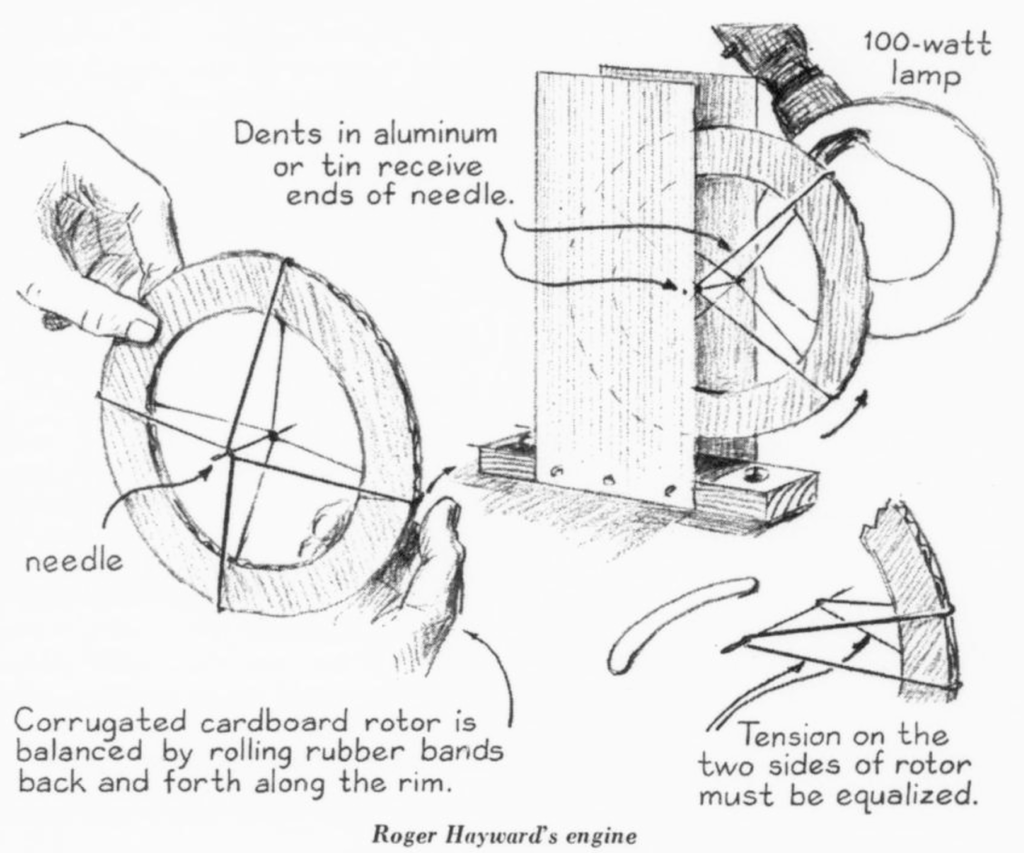
50年代,
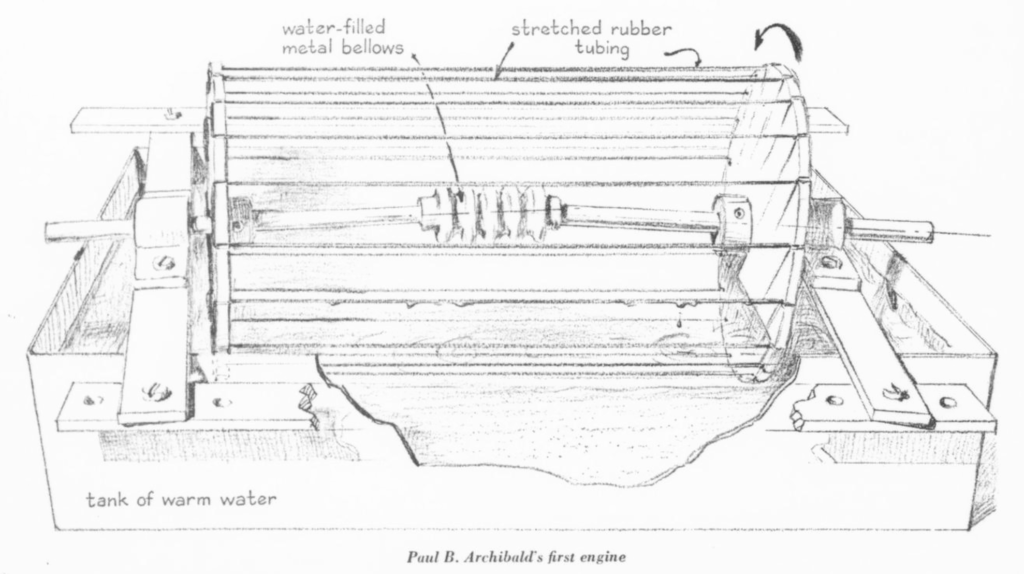
大概在费曼物理学讲义的同年,加州大学的劳伦斯辐射实验室的Paul. B. Archibald也做了一个热机,由C. L. Stong在《科学美国人》1971年4月作了介绍。同一篇文章也介绍了Wiegand的设计。
Wiegand’s inspiration to construct a rubber engine came one afternoon in 1920 as he was lecturing to a group of students at McGill University. He later gave the following account: “To demonstrate the Joule effect, I strung a bundle of rubber bands from the high ciling of the lecture room and by a weight stretched them to 500 per cent elongation. When a battery of Bunsen burners was placed beneath the stretched rubber, the weight leaped upwards; when the burners were removed, the weight sagged. The students seemed impressed by seeing heat induce contraction. I shared their interest, but in addition I also saw Carnot’s cycle: the reversible cycle in which heat is absorbed at high temperature and discharged at high temperature and discharged at a lower temperature. Here, I thought, is a potential heat engine. Subsequently I shared my hunch with a collaborator, H. F. Schipple, who was endowed with mechanical genius. As a result we constructed two heat engines, one reciprocating (in the form of pendulum) and the other rotating-a rubber motor”
Wiegand, 1920
在费曼之后,也有一些与Wiegand (1925) 设计类似(轮子)的热机报道[4]。
References
- W.B. Wiegand, and J.W. Snyder, "The Rubber Pendulum, the Joule Effect, and the Dynamic Stress-Strain Curve", Rubber Chemistry and Technology, vol. 8, pp. 151-173, 1935. http://dx.doi.org/10.5254/1.3539424
- M.G.M. PRYOR, "Heat Exchanges of a Muscle Model", Nature, vol. 171, pp. 213-213, 1953. http://dx.doi.org/10.1038/171213a0
- E.G. Cox, "A heat engine run by rubber", Journal of Chemical Education, vol. 31, pp. 307, 1954. http://dx.doi.org/10.1021/ed031p307
- J.G. Mullen, G.W. Look, and J. Konkel, "Thermodynamics of a simple rubber-band heat engine", American Journal of Physics, vol. 43, pp. 349-353, 1975. http://dx.doi.org/10.1119/1.9852